
Start with the finished product
Rutile and anatase are two crystal forms of titanium dioxide. Both are used as white pigments, but their suitability depends on the formulation and service conditions. Define whether the finished product will be exposed to sunlight, heat, moisture or chemicals before comparing individual grades.
When to consider rutile
Rutile pigments are commonly considered for exterior coatings, plastics and demanding ink systems. Surface treatment can affect dispersion, durability and compatibility with a binder. Crystal form alone does not establish performance: two rutile grades can behave differently in the same formulation.
When to consider anatase
Anatase grades are used in applications such as selected interior paints, paper and rubber formulations. Check brightness, undertone, dispersion and process compatibility against your target. Do not substitute an anatase grade into a weather resistant product solely on the basis of initial whiteness or purchase price.
Validate with a controlled trial
Request the current technical data sheet, safety data sheet and available batch documentation. Compare hiding power, tinting strength, dispersion, gloss and stability at a consistent formulation and test method. For outdoor use, include an appropriate weathering assessment. Send your application, existing grade and performance targets to Longtai Chemical for a product discussion.
For chemical-identity references, compare NIST Chemistry WebBook: rutile (TiO2) and NIST Chemistry WebBook: anatase titanium dioxide. These records identify the crystal forms; grade performance still requires the supplier’s current data and application testing.
Build a comparison around the end use
| Decision | Rutile evaluation | Anatase evaluation |
|---|---|---|
| Exterior service | Evaluate a suitable surface-treated rutile grade in the complete coating or polymer system. | Do not infer exterior durability from initial powder whiteness. |
| Interior appearance | Measure contrast ratio, gloss and undertone in the actual binder. | Compare initial colour and hiding power at equivalent finished performance. |
| Process compatibility | Check the individual grade’s surface treatment and dispersion. | Check dispersion and the requirements of the specific paper, rubber or fibre process. |
The crystalline form is only one selection factor. Two rutile products can differ in surface treatment and dispersion behaviour, while a high-purity anatase specification does not establish suitability for every fibre line. Keep the binder, pigment loading, dispersant, milling conditions and application thickness constant during a first comparison.
A practical Longtai shortlist
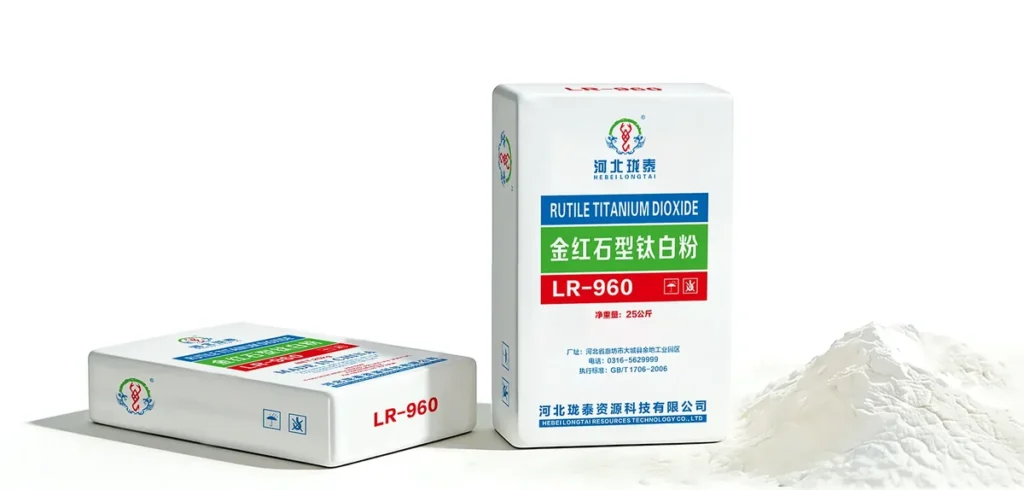
Start with LR960 multipurpose rutile TiO2 for a broad application discussion, and review the anatase series separately. For water-based paper or paint systems, compare the dedicated LR962 entry rather than selecting on crystal form alone. Record the sample code, document revision and test conditions so the result can be repeated.
The LR-960 TDS applies to LR-960. Request matching technical data for other grades. Agree on the finished-product acceptance criteria before interpreting any apparent cost advantage.